Every Generation of Fintech Developers Rewrites the Same Mess
Legacy rails, stablecoin rails, different tools, same piecemealing. Here's why the stack never gets simpler and what it actually costs you

Julian Rachman

Building a Financial Product in 2026
Picture this: you’re a fintech developer who wants to embed a new financial product into your platform. Maybe it's a wallet, a card program, a way for your users to hold and spend a balance. So you start making some calls.
Within two weeks you're deep in vendor evaluations you never anticipated. You need a card issuer, so you're looking at Marqeta or Lithic. You need a banking core, so you're talking to Unit, Column, Treasury Prime, or Synctera. You need KYC and AML coverage, so you're demoing Persona and Alloy. Then don’t forget ledgering and reconciliation, an FBO account, and sweep coverage for FDIC purposes, which means finding a bank partner willing to work with you at all. And somewhere near the bottom of the list, almost as an afterthought, someone mentions that you probably want to do something about the yield on your idle balances.
That's five or six vendors before you've written a single line of product code. Five or six contracts to negotiate. Five or six integrations to build, maintain, and debug across systems that were never designed to talk to each other.
At this point you have two options:
- wrangle it yourself, which means months of integration work, a dedicated ops function to manage vendor relationships, and an engineering team that spends more time on plumbing than on product, or
- you hire a wrangler: a BaaS provider/consultancy who promises to abstract the complexity away
The problem is the underlying vendors don't disappear. Galileo is still there. The sponsor bank is still there. The wrangler just sits on top and takes a margin for making it look cleaner. You pay twice: once to the infrastructure, once to the abstraction. You rent access to someone else's stack, on someone else's timeline, at someone else's price.
The fragmentation is not a bug anyone is working to fix. For the wranglers, it is the business model.
Enter Stablecoins, Stage Left
At some point the industry started saying that building on stablecoin rails would fix this. Programmable money, composable primitives, and open infrastructure anyone could build on. The promise was that you'd no longer need the patchwork of legacy vendors and can ship global financial products easily.
Look at the stablecoin infrastructure landscape today, there’s a lot of players serving very specific parts of the fintech stack.
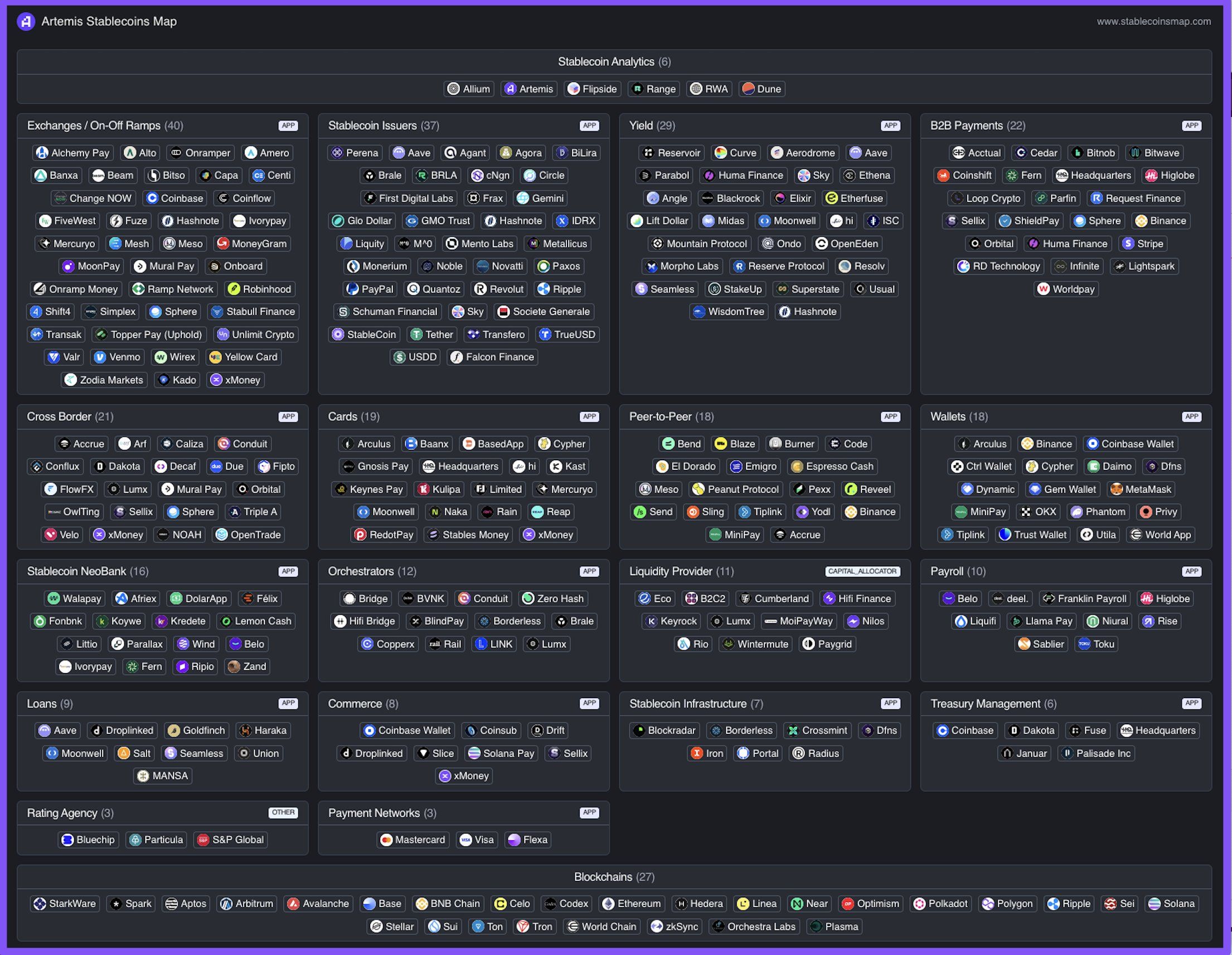
There are currently 26 stablecoin issuers competing for your attention. 33 stablecoin infrastructure providers. 21 yield and money market products. 17 card issuance options. Separate categories for wallets, cross-border rails, B2B payments, remittance, payroll, and liquidity provision, each with a dozen vendors inside it.
And if you step back and ask what a developer actually needs to ship a financial product, you end up in exactly the same place as before. You need something for earn, borrow/lend, spend: a card issuer that accepts stablecoin backing, receive/accept. Four core behaviors that still require you to go find, evaluate, integrate, and maintain a different vendor for each one. What they really care about is how they can deliver value back to their customers to drive retention and revenue.
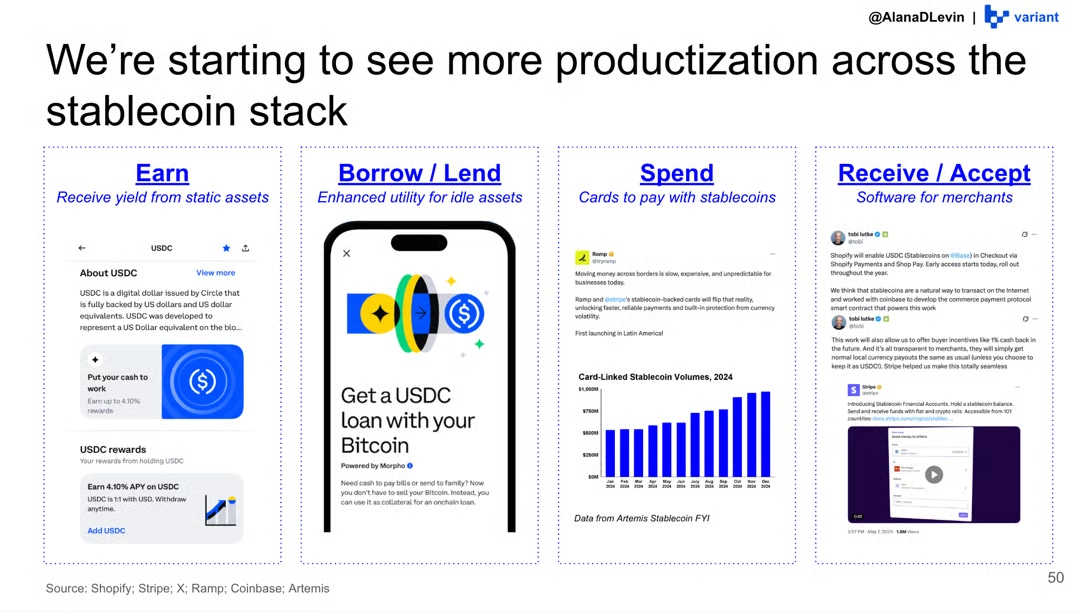
The tools got more interesting, but piecemealing is still the pattern.
Why This Keeps Happening
This isn't a coincidence. It's what happens when an ecosystem optimizes for specialization without anyone optimizing for the layer that connects everything.
In the legacy stack, every vendor solved one narrow problem because they had some special license to do that one thing before anyone else. The integration burden landed on the developer and the coordination cost got outsourced to wranglers who had every incentive to keep the complexity alive.
The stablecoin ecosystem is going down this same path but at a much higher speed. Protocols optimized for their specific primitive: issuance, yield, routing, custody. The assumption was that composability would handle the rest, that developers would just snap the right pieces together. But composability is not the same as integration. Snapping things together still requires you to understand every piece, manage every interface, and absorb every failure mode across the stack. The developer is still the wrangler.
The result is that shipping a financial product, whether on legacy rails or stablecoin rails, still takes months, still requires deep multi-domain expertise, and still produces a stack that is brittle at every seam.
What Actually Needs to Change
Next-generation infrastructure must be designed from the start around the behaviors a financial product actually needs to support: earning yield on idle capital, moving money across rails, issuing spend instruments, accepting payments. Not five vendors for five behaviors. One coherent system where those behaviors are native.
That's what we're building at Otim. A turnkey solution that gives any platform access to the bank business model, collecting deposits and putting them to work, without the legacy infrastructure overhead or the stablecoin wrangling tax. Ship in days, not months. Better financial mechanics out of the box. The same loop that banks have run for centuries, available to any developer building a financial product today.
Stablecoins have given us a brand-new, composable backbone for building new financial products. Pairing them with bare metal traditional fintech mechanics into a single turnkey system, that's how the next generation of financial products gets built, not assembled.
---
If you're building a financial product and want a turnkey solution to launch in days not months, let's chat!